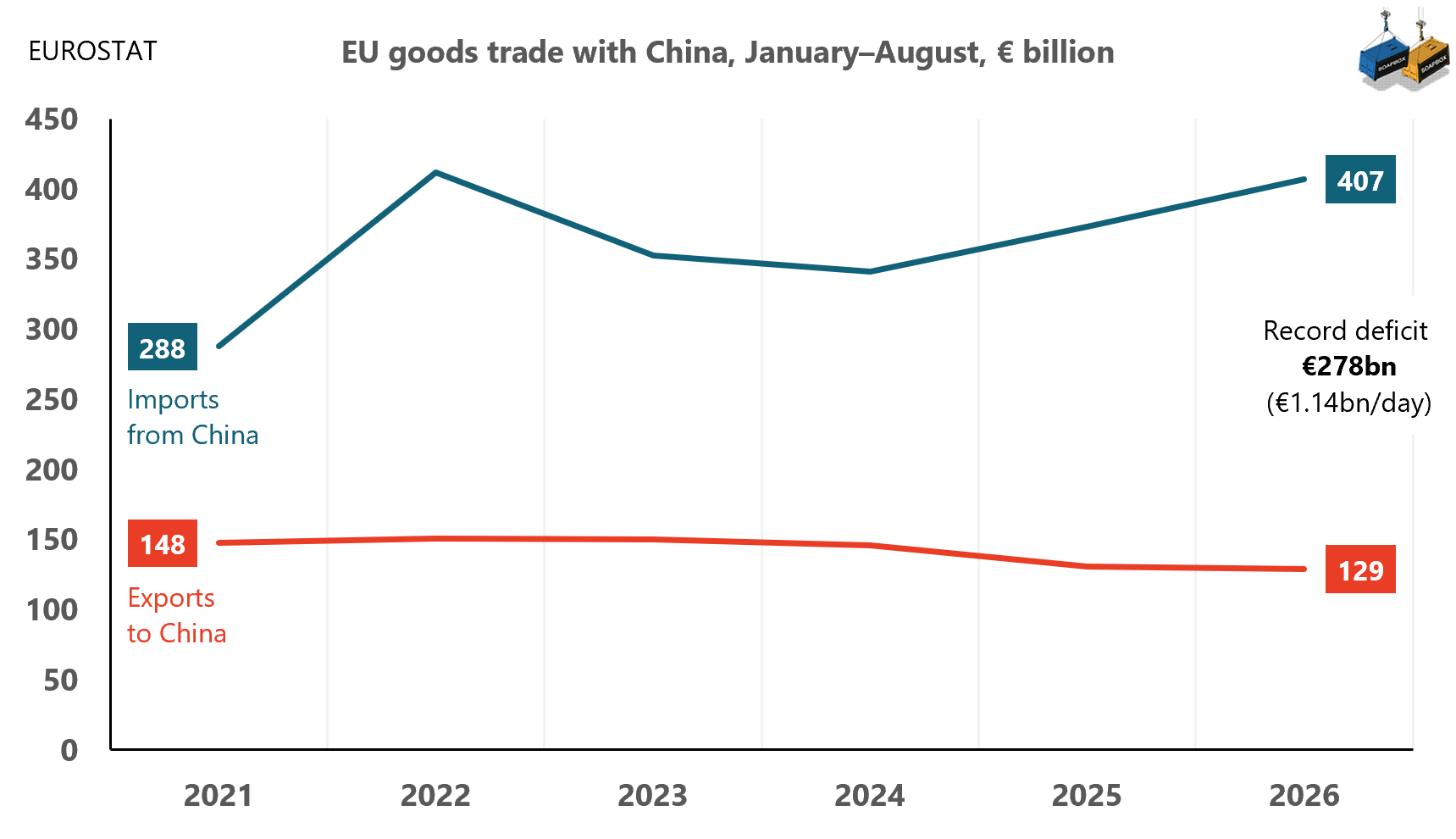
Eurostat data for August are out, and the EU’s goods-trade deficit with China reached €278 billion in the first eight months of 2026, the worst January–August balance on record. The deficit widened by €36 billion, or 15%, in a single year.
The EU imported €407 billion in goods from China, 9% more than during the same period in 2025. Its exports to China fell by 2% to €129 billion. For every €1 of goods the EU sold to China, it bought €3.16.
August offered no sign of rebalancing. EU imports from China rose by 19.7% year on year to €53.1 billion, while exports increased by only 3.2% to €14.7 billion. The monthly deficit widened from €30.1 billion to €38.4 billion.
The longer comparison is even more revealing. Since 2021, EU imports from China have risen by 41%, while EU exports to China have fallen by 13%. Imports remain just below their exceptional 2022 peak, but exports are now the lowest in the series. The record deficit is therefore not simply the result of another Chinese export surge. It also reflects the continuing erosion of EU sales to China.
It is clear that the EU's deficit data with China will only deteriorate by the end of 2026. See the next entry with data from China side.
EU-China, an increasingly one-sided trading relationship
Here we examine the same trade flow from the Chinese side. China Customs records exports when goods leave China, several weeks before many of them arrive and are recorded as EU imports. The two datasets do not match exactly, but China’s figures offer an early indication of what may soon appear in the EU data.
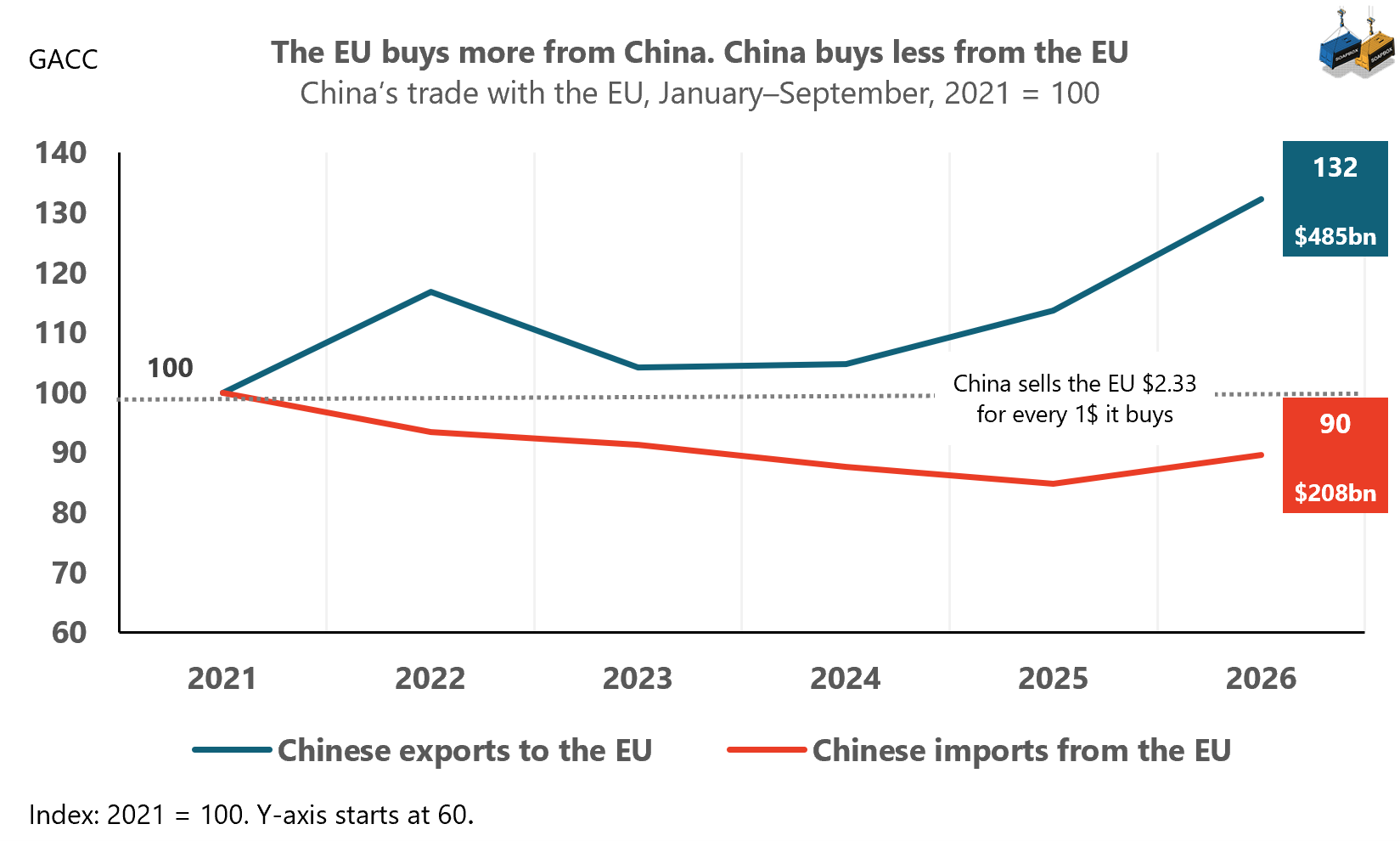
During the first nine months of 2026, China exported $485 billion of goods to the EU and imported only $208 billion in return. Compared with the same period in 2021, Chinese exports to the EU have risen by 32%, while imports from the EU have fallen by 10%.
The result is no longer simply a large imbalance. China now sells the EU $2.33 of goods for every dollar it buys. Its bilateral surplus reached $277 billion, more than double the 2021 level and slightly more than $1 billion a day.
The deeper change is on the import side. The EU still absorbs 14.4% of Chinese exports, but supplies only 8.6% of China’s imports, down from 11.8% in 2021. China’s total imports increased by $528 billion this year, yet purchases from the EU accounted for only $11 billion of that increase.
The EU generated around 30% of China’s entire goods surplus. It remains an important customer for China, but its position as a supplier to China continues to diminish.
That is not rebalancing. It is an increasingly one-sided trading relationship.
China’s surplus with the EU grows over three times as fast as elsewhere
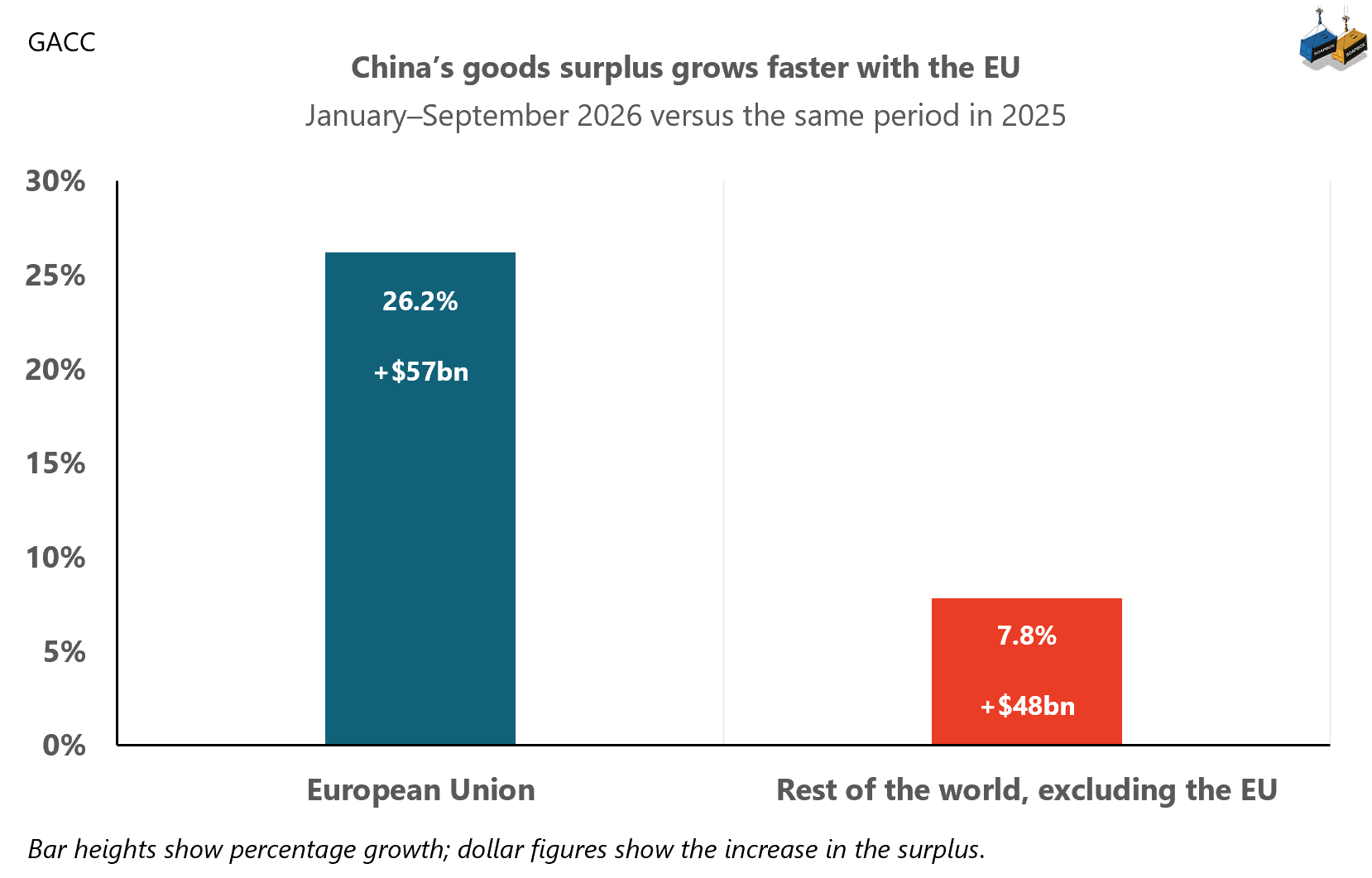
China’s goods trade surplus with the EU grew by 26.2% in January–September 2026, compared with 7.8% with the rest of the world.
The surplus with the EU reached $277 billion, an increase of approximately $57 billion. With all other trading partners combined, it rose by $48 billion. The EU alone therefore accounted for more than half the increase in China’s global goods surplus.
Its share of the total surplus also increased, from 26.4% to 29.6% compared with January–September 2025.
Why has China accepted a sharp cut in hybrid exports to the EU?
China has agreed to curb exports of hybrid cars to the EU. The reported ceiling is 350,000 vehicles in 2027, compared with around 800,000 expected in 2026. For EU’s car industry, that promises a substantial reduction in competition from imports.
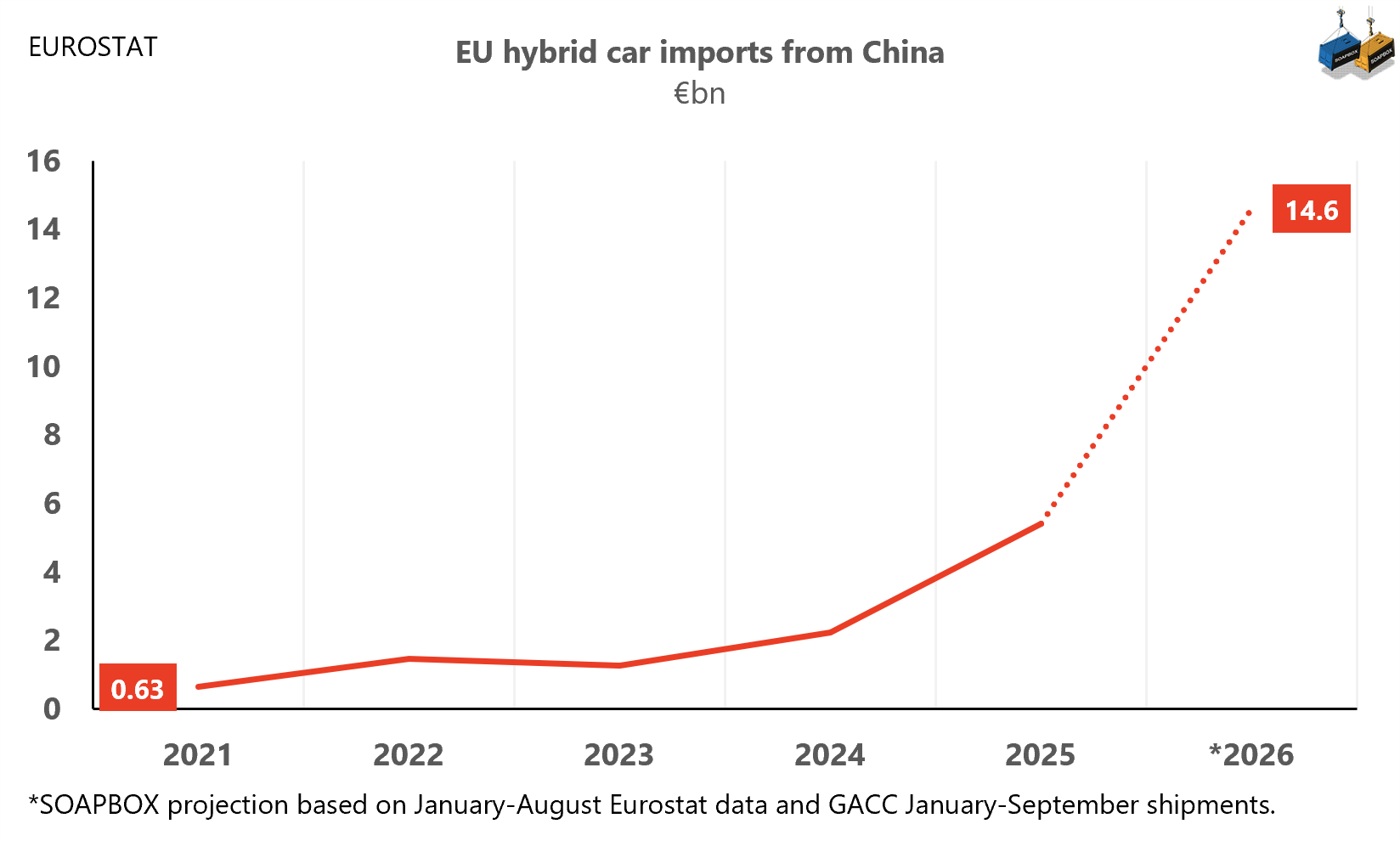
SOAPBOX forecasts that EU hybrid imports from China will reach €14.6 billion in 2026, up from €5.4 billion in 2025. Eurostat’s January–August figures and Chinese customs shipments through September support our earlier estimate.
At approximately €18,000 per car at the EU customs border, 350,000 vehicles would represent imports worth €6.3 billion. That is €8.3 billion, or 57%, below our 2026 forecast. This calculation assumes broadly unchanged average import values.
Selling more expensive models could soften the reduction. But maintaining €14.6 billion within the quota would require an average customs value of approximately €42,000 per vehicle, more than double the current indicative average. That is before retail taxes and distribution margins.
Why would Beijing accept such a reduction in business when Chinese factories need export orders?
China’s machinery and electronics exporters’ chamber argues that negotiations secured a larger quota than a unilateral European restriction might have allowed. This offers an explanation for accepting the agreement, although the alternative it describes has not been independently established.
Beijing also negotiated beyond the car industry. The wider package includes European commitments to facilitate certain dual-use exports to China and continue work on alternatives to additional duties on Chinese-made battery-electric cars. These could bring benefits elsewhere, but their practical value remains uncertain.
Manufacturing in the EU could sustain Chinese companies’ expansion and orders for Chinese components. It would not, however, preserve the same production and employment in China. Nor do fewer hybrid imports necessarily mean an equivalent reduction in EU’s overall import bill if other vehicles or components take their place.
Beijing may have accepted a real industrial cost to avoid worse restrictions and secure benefits elsewhere. Our figures show how substantial that cost could be. The public explanations still leave unclear how much Chinese production would be retained, and what Beijing expects to gain in return.
EU electric car imports from China recover despite tariffs
Alongside the hybrid surge, EU imports of battery-electric cars from China are recovering. Annualising Eurostat’s January–August figures puts their value at €9.3 billion in 2026, up 47% from 2025.
The rebound follows two years of decline. It would take imports above their 2024 value, although still below the €11 billion peak reached in 2023. Additional tariffs have not prevented this recovery, even if imports might have grown further without them.
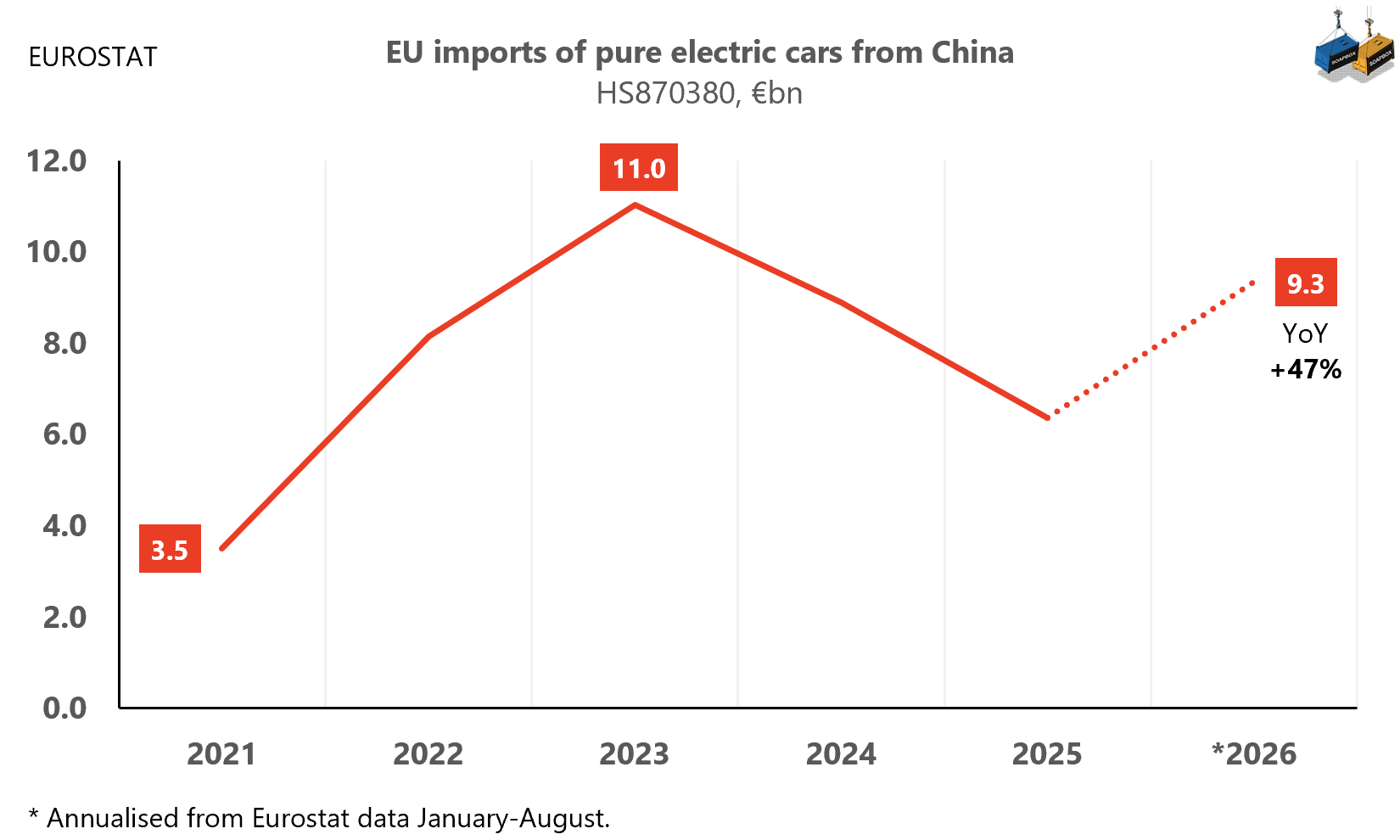
Together with SOAPBOX’s €14.6 billion hybrid forecast, the figures point to approximately €24 billion of imports across both categories in 2026, roughly twice their combined value in 2025.
This gives the hybrid agreement a wider context. Beijing still has a growing battery-electric export business supplying Europe. Whether that business can absorb some demand displaced by the hybrid quota remains uncertain, but it is a channel worth watching.
For the EU, the eventual test will be what happens to vehicle imports overall.
Where is China’s tariff-era surplus accumulating?
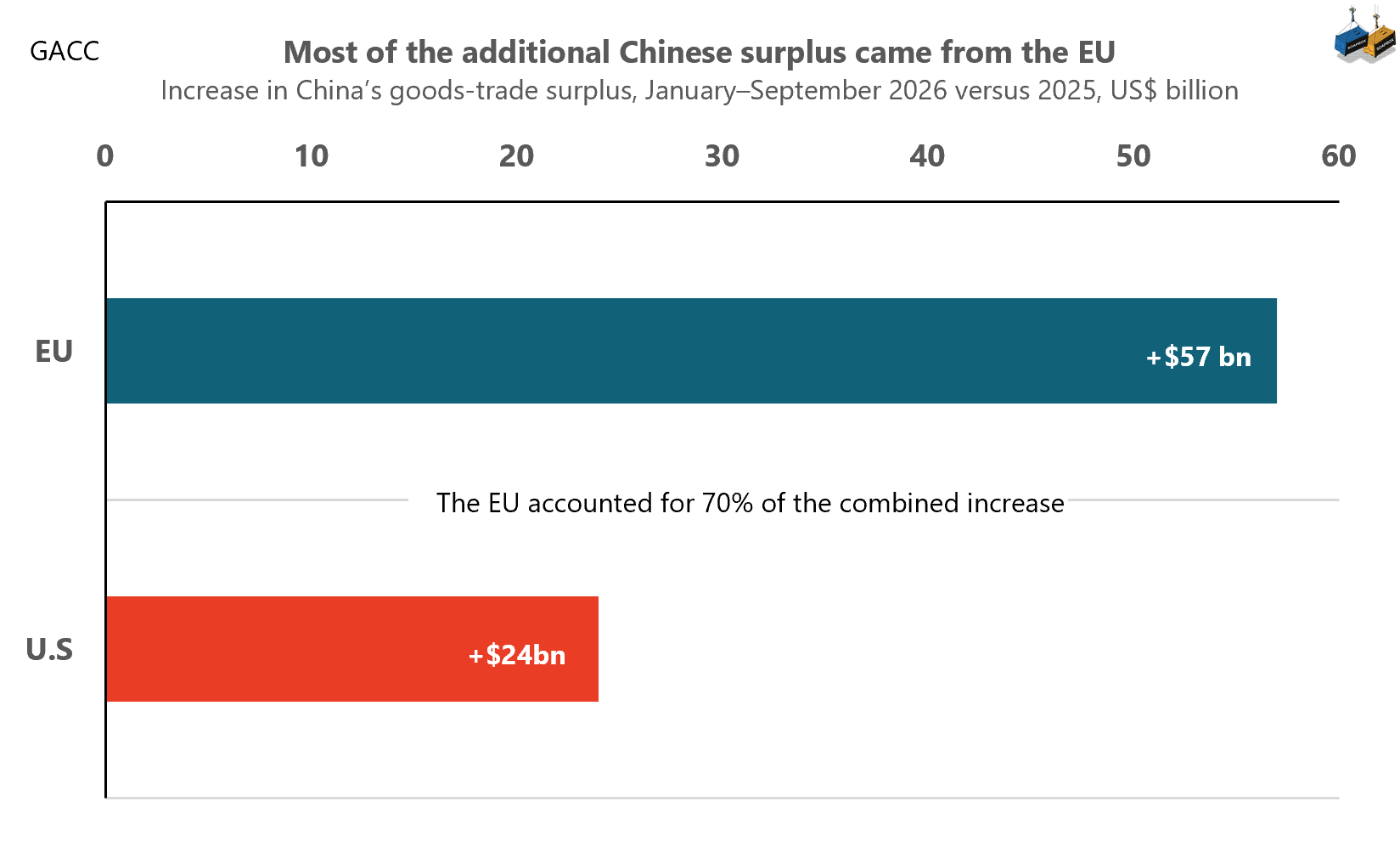
Twenty months into Donald Trump’s second term, China’s goods-trade surplus is still growing with both the United States and the EU. But the additional surplus is accumulating much faster in the EU. In January–September 2026, China’s surplus with the EU increased by $57 billion, compared with $24 billion with the US.
The EU accounted for 70% of the combined increase.
China sells more to Germany while buying less
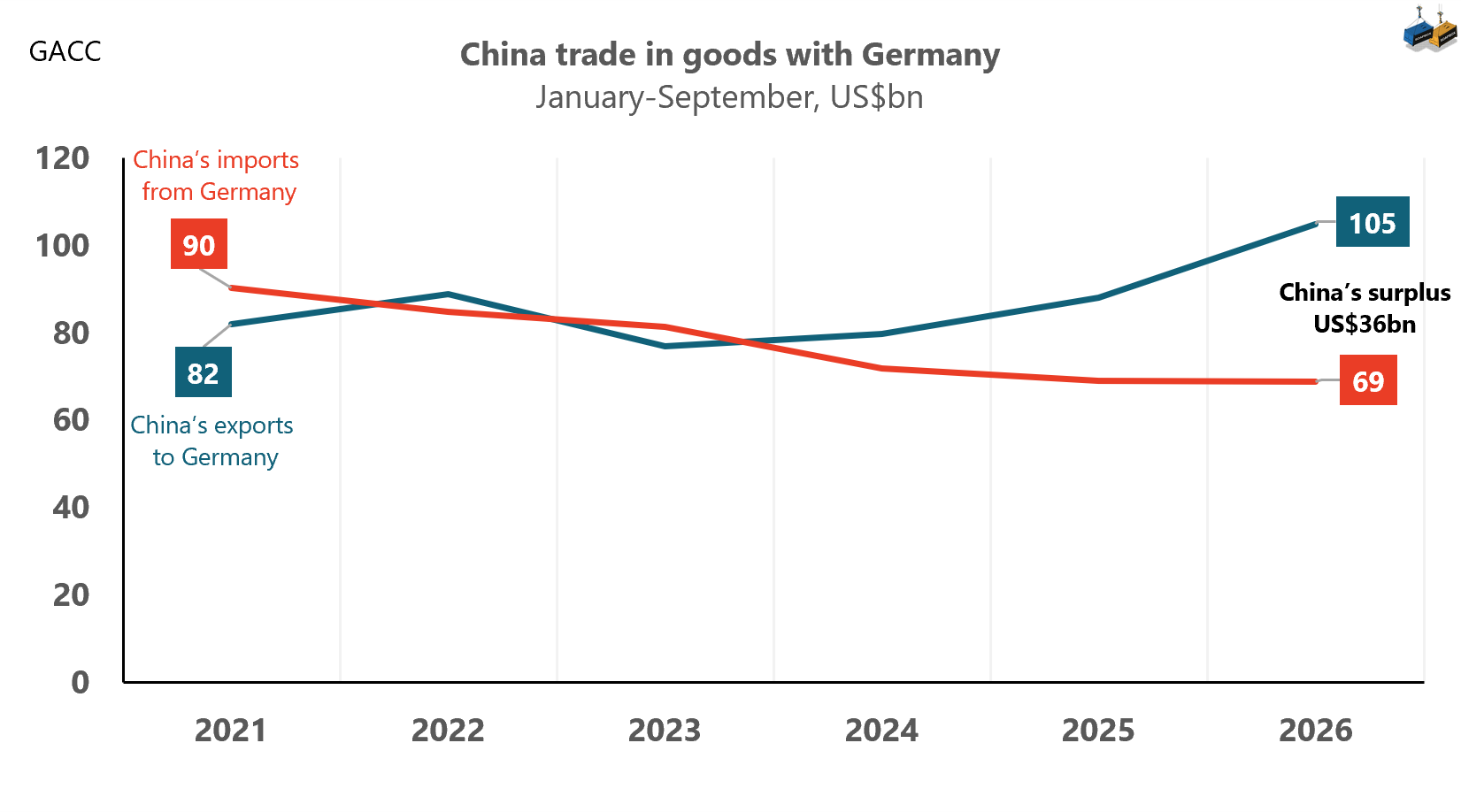
China’s goods trade with Germany totalled approximately $174 billion in January–September 2026, little different from $172 billion in the same period of 2021.
Yet the trade balance has changed dramatically.
Chinese customs figures show exports to Germany rising from $82 billion to $105 billion, while imports from Germany fell from $90 billion to $69 billion. China’s balance consequently swung from an $8 billion deficit to a $36 billion surplus.
The latest year deepens that divergence. China’s sales to Germany increased substantially, while its purchases remained broadly unchanged.
China’s goods trade surplus runs at $3.5 billion a day
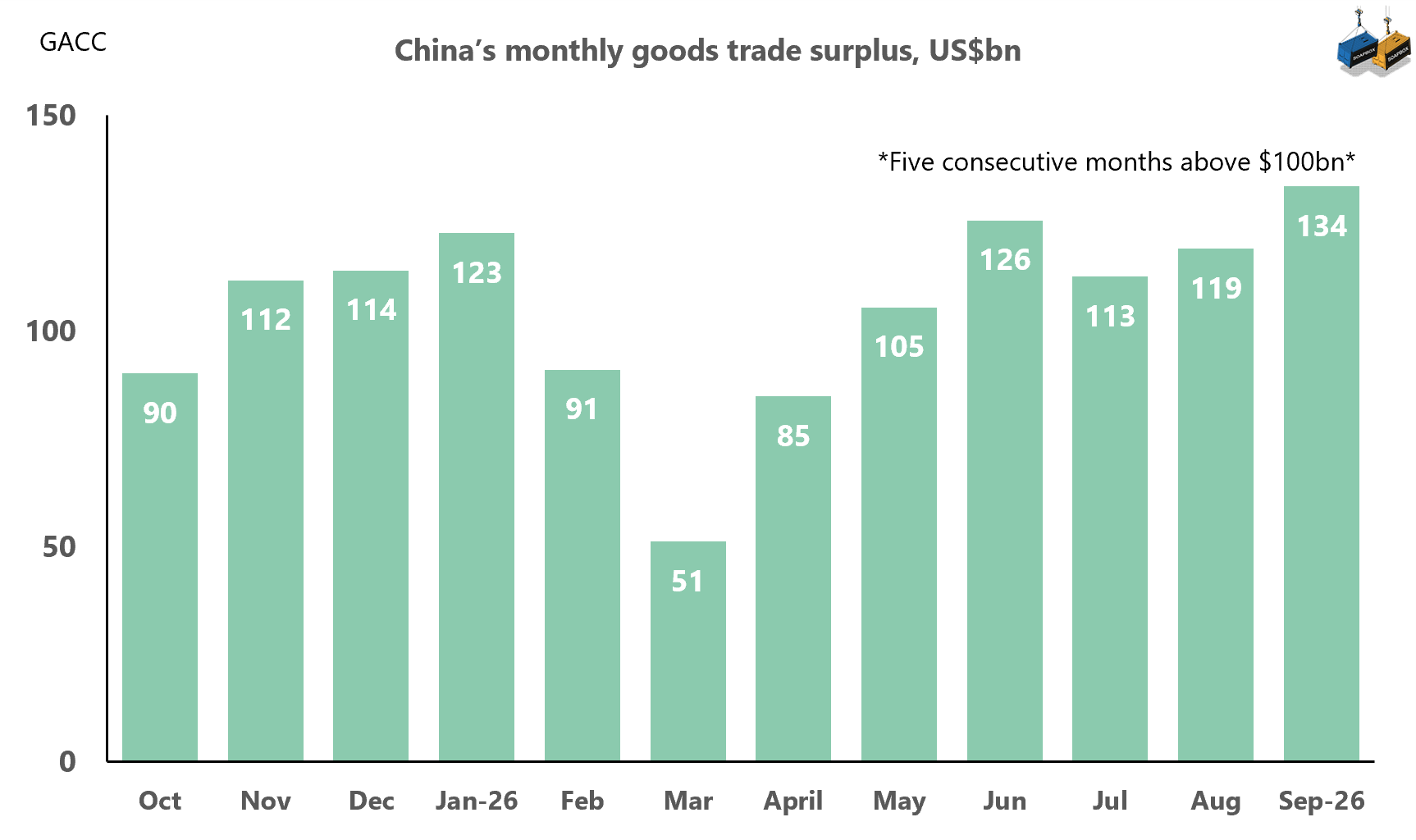
China recorded a $134 billion goods trade surplus in September, its largest monthly surplus ever. It was also the fifth consecutive month above $100 billion. Over January–September, the surplus increased by 7.7% compared with the same period in 2025.
The surplus accumulated over the twelve months to September reached $1.26 trillion. A projection based on the first nine months puts the full-year 2026 figure at $1.28 trillion, equivalent to around $3.5 billion a day.
To put that scale in perspective, China’s projected annual goods surplus alone would equal 1.2% of the combined GDP of every other economy in the world.
Even single-digit growth now adds tens of billions of dollars to an already enormous trade imbalance.
China’s factory prices rise faster while consumer inflation stays subdued
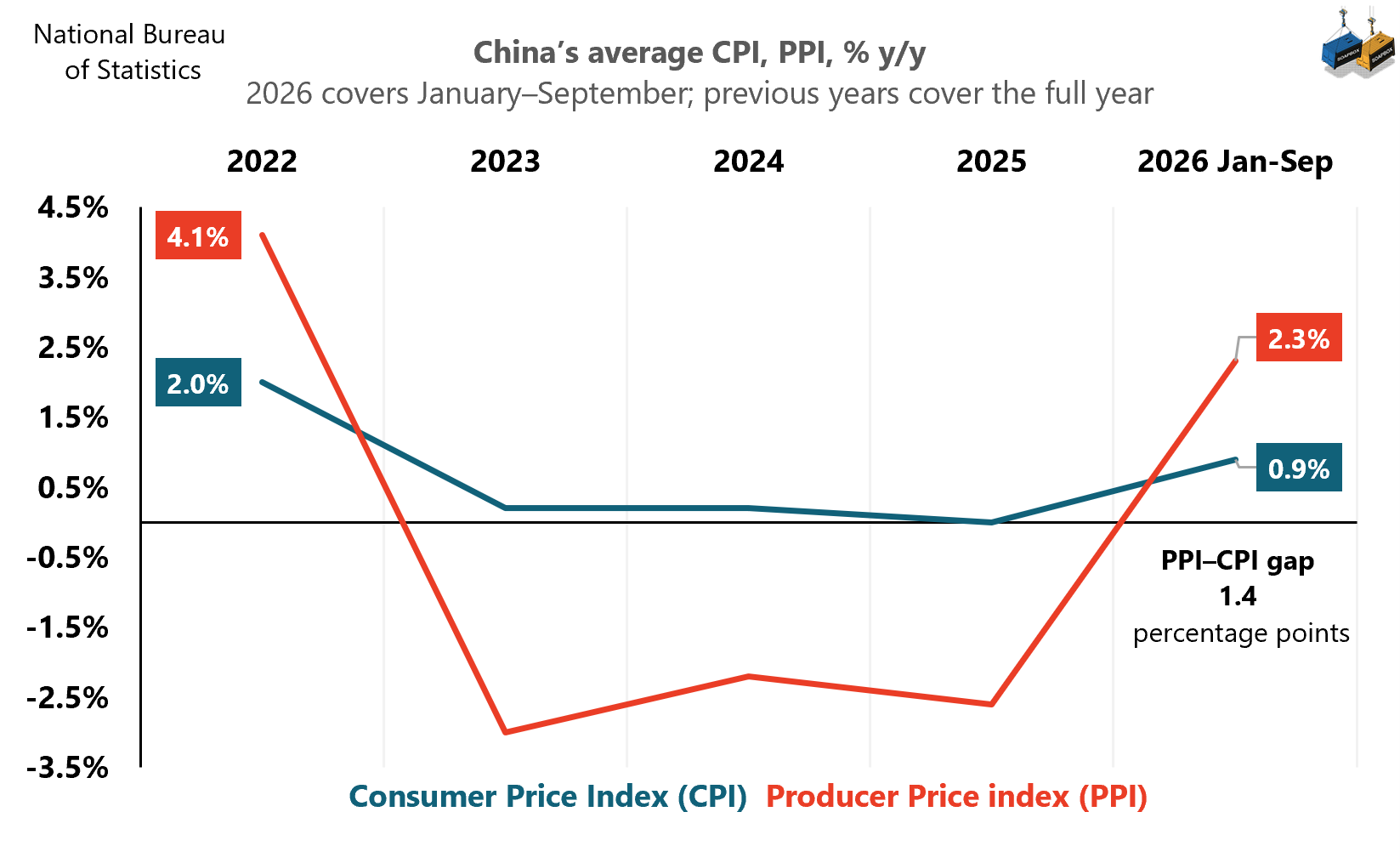
China’s producer prices rose by an average of 2.3% in January–September, compared with the same period last year, while consumer prices increased by 0.9%. The gap widened to 1.4 percentage points, from 1.1 in January–August, as producer inflation accelerated and consumer inflation remained unchanged.
Crude oil and metal prices among the drivers of September’s industrial price increases. Rising factory prices therefore cannot be read as stronger household demand. China’s industrial prices are increasing faster than the prices consumers pay.
China’s missing 470 million barrels
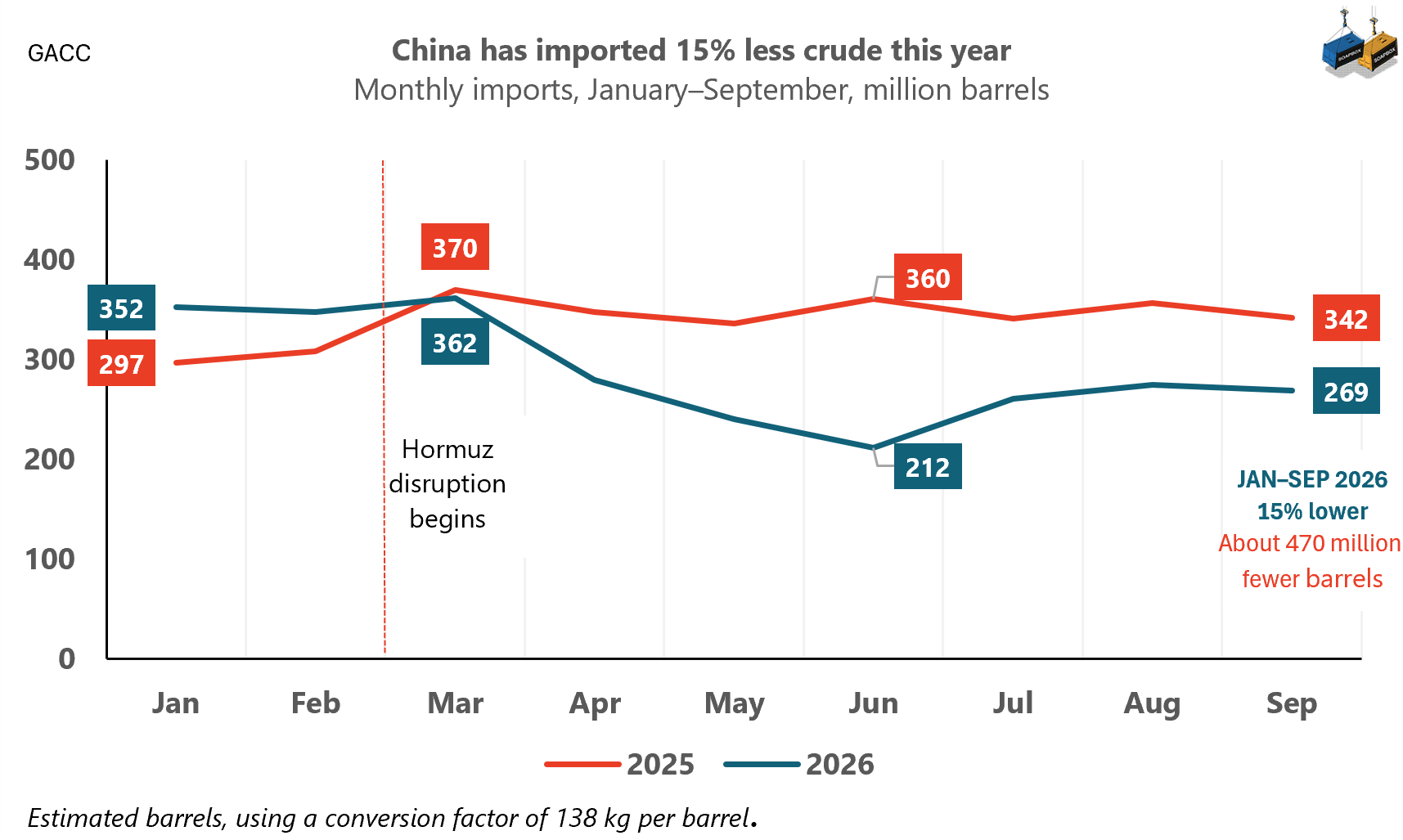
China imported 15% less crude oil in January–September than a year earlier, equivalent to roughly 470 million barrels. The disruption at Hormuz provides the immediate explanation. Record imports in 2025 had also left China with substantial stocks, while lower refinery runs and weaker fuel demand have reduced its needs this year.
But the scale remains difficult to reconcile with the wider economic picture. China reports continued growth, resilient manufacturing and surging exports. Greater electrification can reduce demand for transport fuels, but an economy does not become 15% less dependent on imported crude in nine months.
The gap has so far been bridged partly by inventories. As those stocks decline, China must either restore imports, process still less crude or reveal that underlying industrial and domestic demand is weaker than the headline indicators suggest. The oil data do not settle that question. They make it increasingly difficult to ignore.
China’s missing imports are equivalent to almost everything Libya produces in an entire year.
Peru's dilemma over a planned megaport
Peruvian authorities are advancing the planned Corío port in the southern region of Arequipa. Its master plan was approved in September, and the estimated $844 million project has attracted interest from investors in the United States, China, India and other countries.
Corío would add another major terminal to Peru’s Pacific coast, alongside Chancay, which was inaugurated during Xi Jinping’s visit in November 2024 and is majority-owned by China’s state-owned COSCO Shipping group. Regional authorities highlight Corío’s naturally deep waters as an advantage for accommodating large vessels.
The range of potential investors gives President Keiko Fujimori’s government an opportunity to attract capital from several sources. But expressions of interest have yet to become investment commitments, and the eventual ownership and operating arrangements remain important questions.
A Chinese-controlled Corío would expand China’s role in Peru’s port infrastructure and could intensify US concerns about its regional influence. Investment from other countries could diversify that presence. The strategic significance will depend on who finances and operates the port, how it connects with inland cargo routes, and the oversight Peru retains.
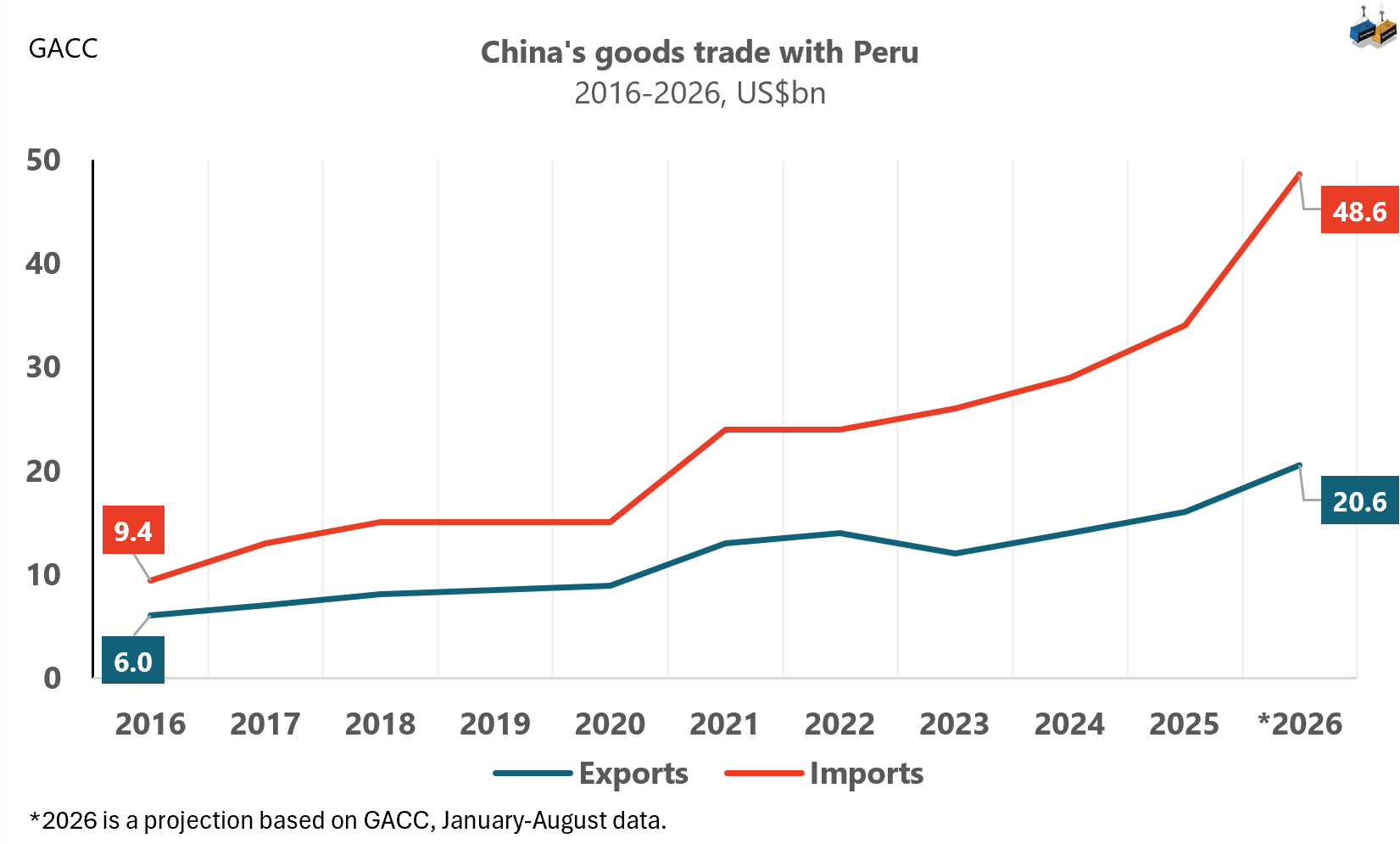
China-Peru trade surged 4.5 times over the last decade, driven by Chinese imports outgrowing exports by 5 percentage points.
Huang Qifan’s call for a smaller Chinese trade surplus
Huang Qifan, the former Chongqing mayor, is under investigation for suspected corruption, according to state media. For trade observers, his recent economic proposals deserve attention.
Huang serves as Executive Vice Chairman of the Academic Committee of the China National Innovation and Development Strategy Research Association. In May 2026, he argued that a sustainable Chinese trade surplus should remain between 2% and 3% of GDP, well below the customs-based figure of 5.7% in June.
His proposals, recorded by Tsinghua, included a moderate appreciation of the renminbi, reduced export tax rebates and lower import tariffs. He also advocated higher worker incomes, turning manufacturing strength into greater household prosperity.
An experienced former policymaker publicly advocated reducing China’s surplus through changes to its own economic policies has now its own woes.
China’s reported US Treasury holdings fall to an 18-year low
The headline should be read with caution. US Treasury data show holdings attributed to mainland China falling by $27.3 billion in August, to $590.7 billion. But this does not necessarily mean that China sold that amount. The data identify the location of the custodian, not always the ultimate owner.
China may hold US securities through European financial centres or Chinese state banks. Holdings attributed to the UK, Belgium, Luxembourg and France increased by a combined $52.1 billion in August.
One clue to the longer-term direction is BRICS Clear. BRICS countries are studying their own system for holding and settling securities, reducing their dependence on Western platforms such as Euroclear. It is a proposal from Russia.
China Q1–Q3 GDP growth aligns with our 4.6% Forecast
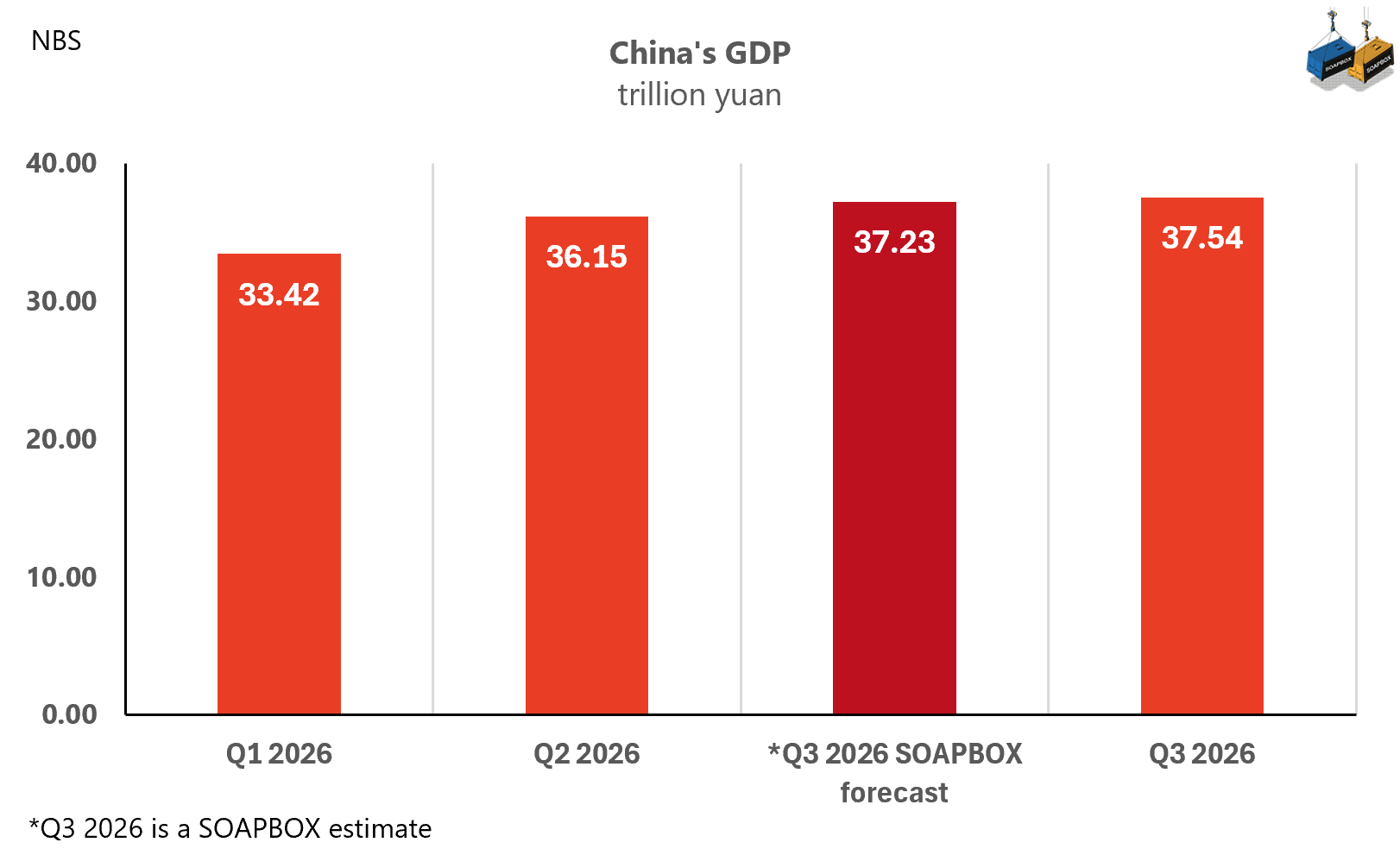
Earlier this month, we released our China GDP forecast, which projected Q3 output at 37.23 trillion yuan and real year-to-date (Q1–Q3) growth at 4.6%.
According to the official data, China’s GDP in Q3 2026 was 37.54 trillion yuan at current prices. China’s real GDP growth in Q1–Q3 2026 was 4.6% year on year.